Pelvic floor training for men
It's the muscle behind timing, firmness and bladder control — and the only one you've never measured. Kegel AI scores it in two minutes, then rebuilds it in five minutes a day.
Why it matters
The pelvic floor is a hammock of muscle at the base of the abdomen. It closes the urethra, holds blood in during an erection, and fires at the moment of ejaculation. Three jobs men care about, one muscle group doing all of them.
It weakens the same way anything else does — sitting, age, no stimulus. The difference is that nobody notices until something goes wrong, and by then it feels like a personal failure rather than a training gap.
Pelvic floor muscle training is first-line clinical treatment for stress incontinence and has been trialled for erectile and ejaculatory control. The exercise was never the hard part. Doing it every day, correctly, and knowing whether it's working — that's the part that needed solving.
Four outcomes, one muscle group. This is standard urology — not a hack.
Ejaculation timing is muscle control. A stronger, faster-responding floor means the moment is yours to choose.
The pelvic floor traps blood under pressure during an erection. A slack one holds less, for less time.
A cough, a lift, a sprint. Pelvic floor training is the first thing urologists prescribe for stress incontinence.
The quiet one. When you're not silently managing it in the background, everything else in the room gets easier.
The measurement
Most apps count seconds at you and never say whether anything is working. Kegel AI runs a timed hold-and-release test and turns it into a single score you can track.
Example readout. Your own numbers depend on where you start.
Press and hold. Ten seconds closes the ring — that's the floor, not the target.
This one only tests your thumb. The real test reads the muscle itself.
Inside the app
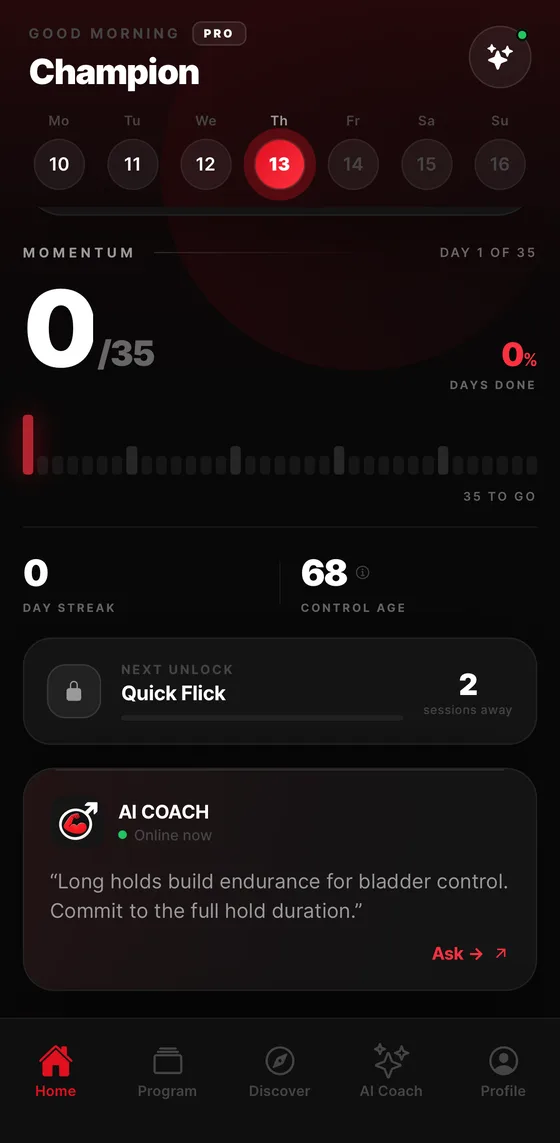
Not a timer with a logo on it. A plan that rebuilds itself, a session you can run face-down, and a screen that tells you whether any of it is working.
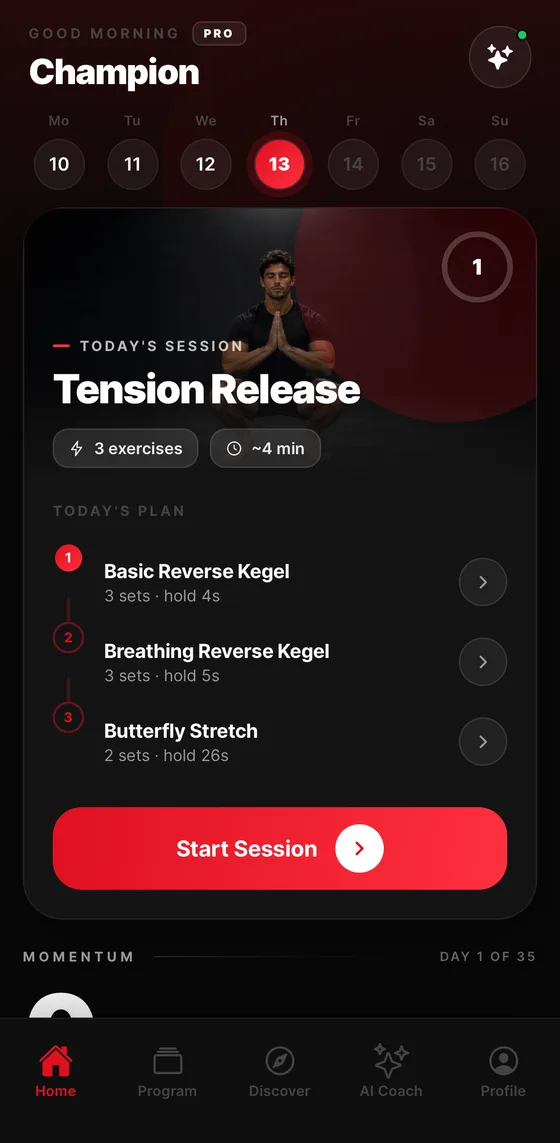
Three exercises, about four minutes. No deciding what to do — it's decided.
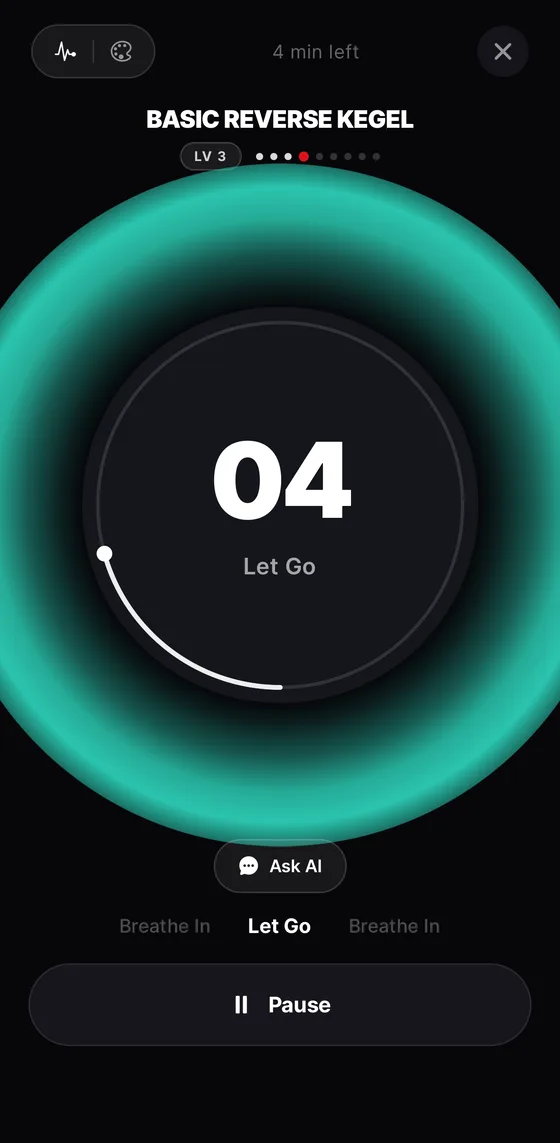
Most men squeeze fine and never fully let go. The release half is where the control is.
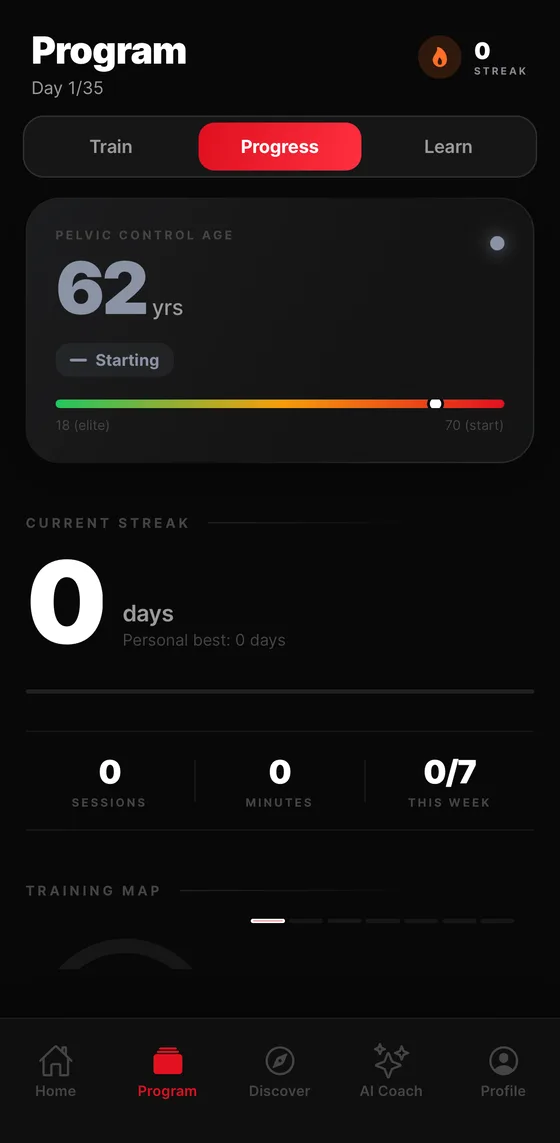
Where you sit between 70 and 18, updated as you re-test. Numbers, not encouragement.
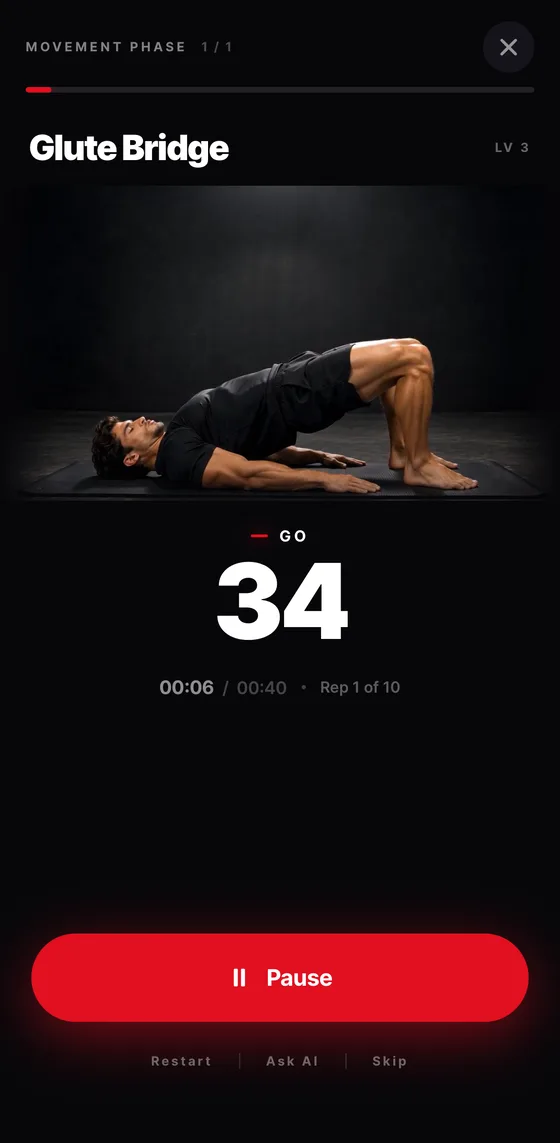
Every movement has a demonstration and a rep count. You are never guessing what it looks like.
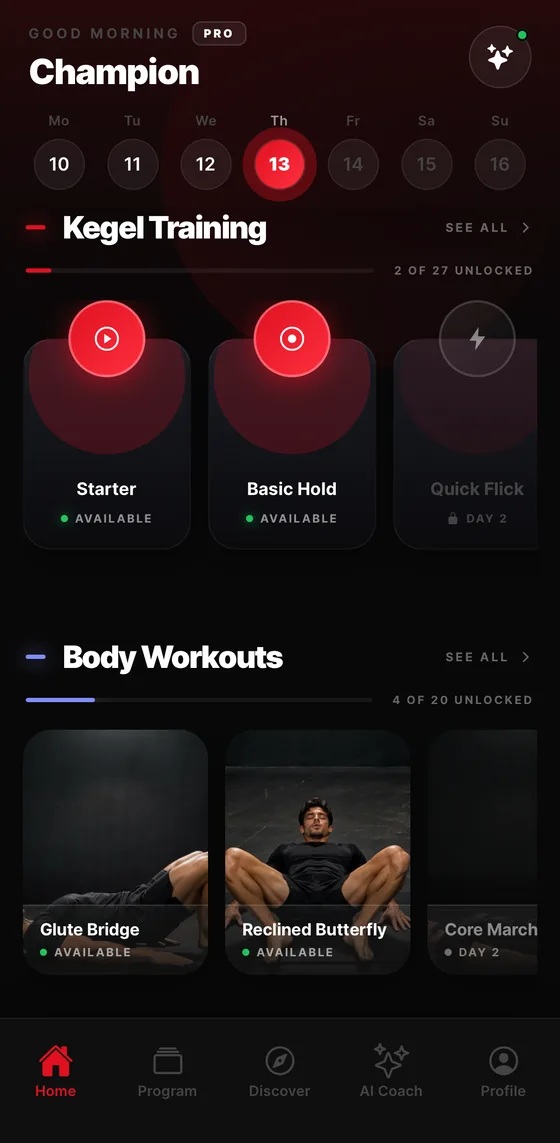
They unlock as you earn them, so day one isn't a wall of things you can't do yet.
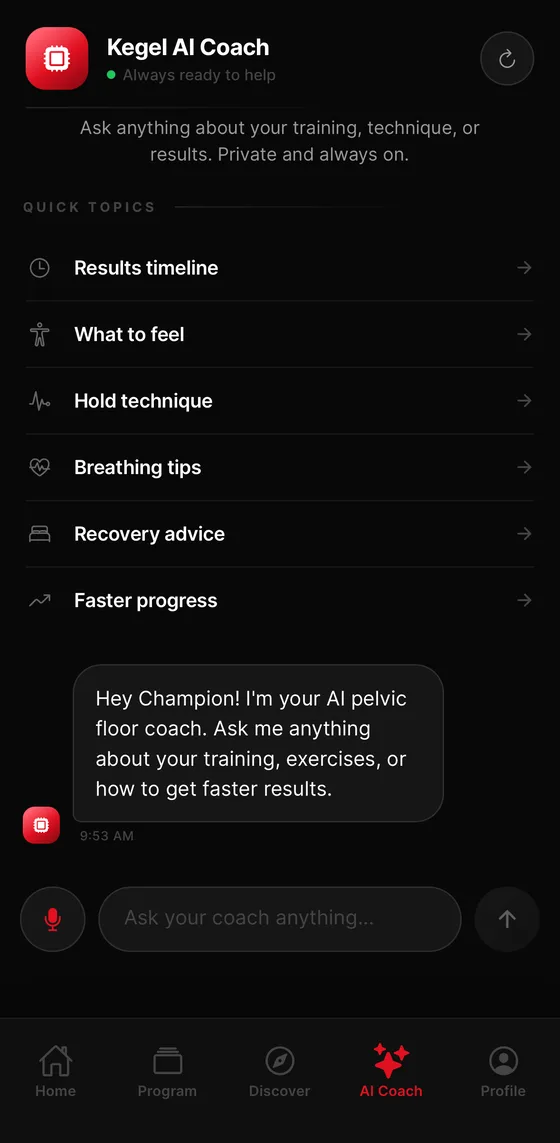
Form, timing, setbacks, whether it's normal. Answered in context, at 2am, privately.
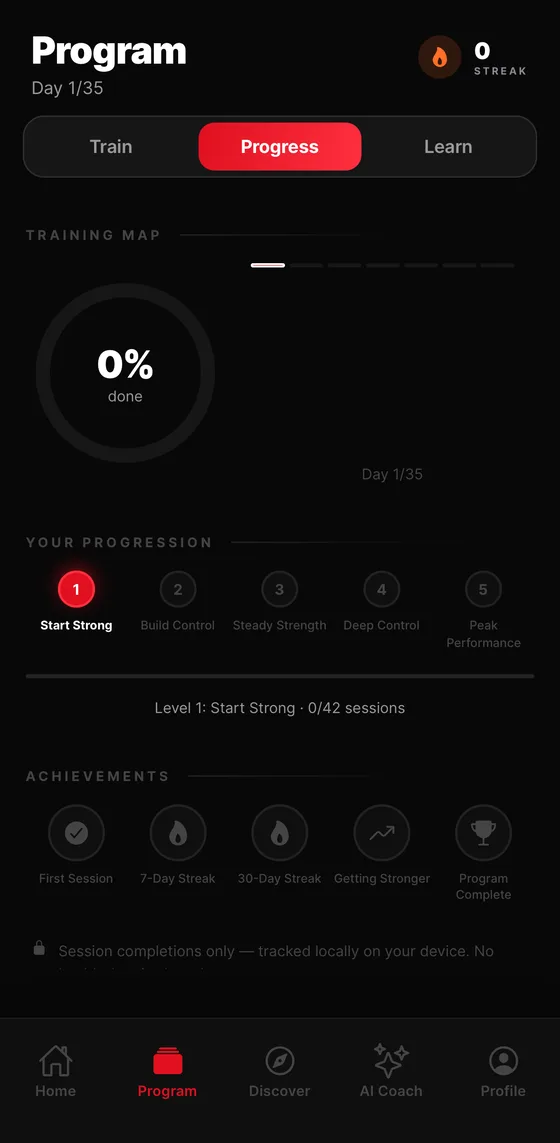
Start Strong through Peak Performance. You can see how far in you are and what's next.

What the muscle does, what makes it worse, what actually changes results.
Swipe to see more →
The training
You cannot strengthen a muscle you cannot locate, so day one assumes day one. Week six is the first checkpoint — not the finish line.
Fire the right muscle without clenching glutes, abs, or holding your breath. Most men get this wrong for years.
Longer holds, shorter rests. Endurance is what keeps pressure where you want it, for as long as you want it.
Fast-twitch reps and timed drills. Strength is useless unless the muscle answers the instant you call it.
Discretion
This is the real reason most men never start. It was designed in from the first screen, not bolted on as a settings toggle.
The test is free and needs no card. If you want the program after it, this is the whole price list — no upsells, no add-ons.
12 months
$49.99$119.88
$0.14 a day. Billed once a year.
1 month
$9.99
$0.33 a day. Cancel any time.
Prices in USD. Cancel from inside the app in two taps — no email, no retention call. Muscle takes weeks to change, so the yearly plan is the one that matches how the training actually works.
Pelvic floor muscle training is first-line clinical treatment for stress urinary incontinence, and randomised trials have measured improvements in erectile function and ejaculatory control. Urologists have prescribed it for decades. The hard part was never the exercise — it was doing it consistently and knowing whether it was working.
A single score from a timed hold-and-release test: how long you can hold, how quickly the muscle responds, and how cleanly you can let go. It's expressed as an age so the number means something on its own — 62 tells you more than "level 3". Your week-six re-test shows whether it moved.
Muscle adaptation takes weeks, not days. Your first re-test is scheduled at week six because that's a realistic window for a measurable change, and training continues from there.
Pelvic floor strength behaves like any other muscle: it keeps building while you train it and fades within weeks if you stop. Anyone promising results in three days is selling something else.
No equipment. Sessions run about five minutes and are audio-guided, so the screen can stay face-down the whole time. The kegel exercises themselves are invisible — most men do them sitting down.
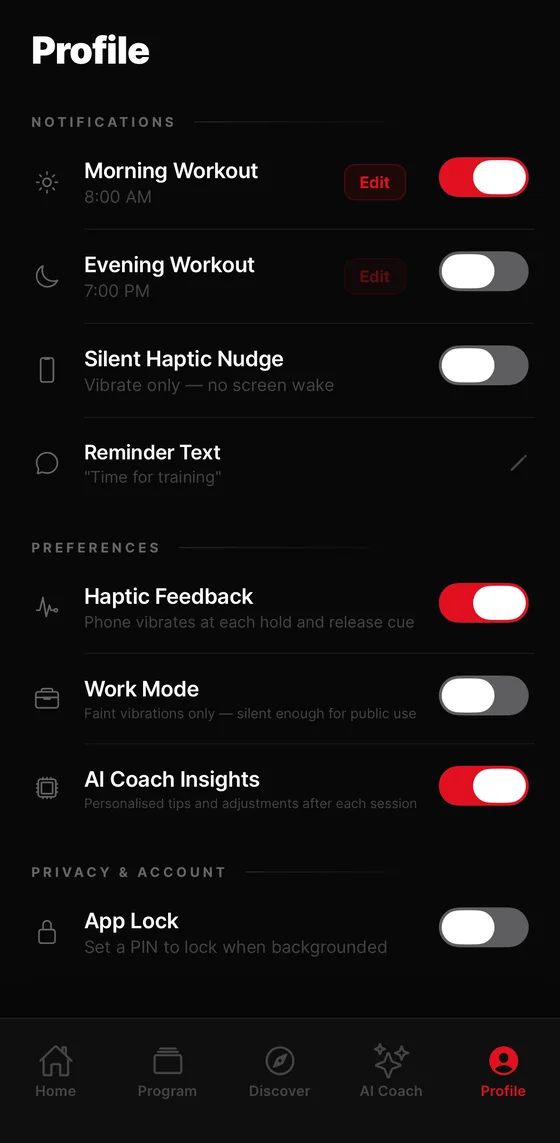
The app locks behind Face ID, notification text is yours to write and never names the condition, and session recording is disabled at the code level. Emails we send are titled neutrally.
Pelvic floor exercises are generally safe for healthy adults. Kegel AI is a fitness and wellbeing app, not a medical device, and it does not diagnose or treat disease. If you have a diagnosed pelvic condition, chronic pelvic pain, or you're recovering from surgery, speak to your doctor before starting.
Two minutes, no card. It asks about your goals and history, runs the timing questions, and returns your estimated control age with a plan built around it. You decide after that whether you want the program.
Profile → Manage Subscription, inside the app. Two taps, no email, no retention call. If you bought on the web, the same screen handles it.
Two minutes from now
Free, no card, and nothing on your screen names it. Then decide whether it's worth five minutes a day.